

After a request concerning my research into barrel racing, I can cover some here concerning my protagonist, Madison’s life. As previously mentioned I am grateful to Kendra Edey, a champion barrel racer, for her kind assistance in understanding the technicalities of a barrel race.
There is a saying within the barrel racing community – learn to take turns. This refers to the series of sharp turns horse and rider take around the clover-leaf shaped course. The faster you can turn the better.
The diagram below, shows the course initially consisted of a figure-eight pattern, but was subsequently replaced by the favored clover-leaf course. This newer course demands a higher skill level for horse and rider to perfect. It is a test of synchronicity between horse and rider at speed.
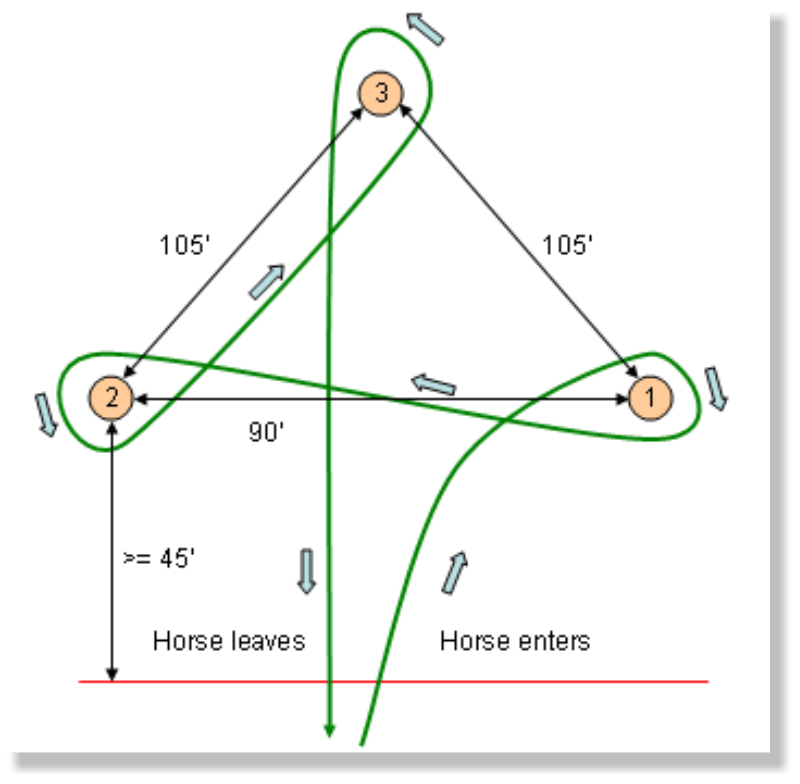
To begin a barrel race, the horse and rider enter the arena at top speed, through the center entrance. An electronic timer beam records the horse and rider as they cross it. This timer runs until the beam is crossed again at the end of the run.
Usually the established distances are as follows:
60 feet (18 m) from barrels 1 and 2 to score line.
90 feet (27 m) between barrel 1 and 2.
105 feet (32 m) between barrel 1 and 3 and between 2 and 3.
Modern barrel-racing horses need to be fast, strong, agile and intelligent. To maneuver the course in as little distance as possible requires physical strength and agility from the horse as well as the ability to follow commands from the rider. Horses that can “hug the barrels” and maneuver the course quickly show up by their consistently low times.
The favored breed for barrel racing is the Canadian, or American Quarter horse. In reference to the Canadian quarter horses, they are descended from draft and light riding horses imported to Canada in the late 1600s from France, it was later crossed with other British and American breeds. During the 18th century the Canadian horse spread throughout the northeastern US. As for American quarter horse the breed began in the 17th century with British thoroughbreds paired with ‘native’ horses, (Chickasaw), which in turn were descended from horses brought over by the Conquistadors. Such as the Iberian, Arabian and Barb and wild horses.
As you can see research covers a lot more than is contained within the novel, however, the more informed the author the more realistic the narrative.

Subsequent to writing my narrative, I found out a ‘reality’ TV program was on air – Rodeo Girls. However, the authenticity of its portrayal of women in rodeo is open to discussion due to the glamorization and falsifying of ‘real’ life for these extraordinarily skilled women. I am happy to declare my narrative is true to the real barrel racers and their lifestyle.
THE NOVEL
Willow Tree Tears is a western romance, following my protagonist, Madison, a champion barrel racing young woman. She is determined and focused in her sport and lives on a Quarter horse stud with her widowed father. In the story, Madison must decide between two men vying for her love. A man she has known since high school and who lives the ranching and rodeo life and a suave globe trotting Italian. Can she resist the lure of the unfamiliar? Is marrying her ‘kind’ best for her and her father’s hopes for her future and the ranch?
You can find Willow Tree Tears on multiple online purchase sites. Link
0 Comments